Heather Watkins
Building a successful reuse program rarely comes down to one big decision. It comes down to operational changes, teams that stay dedicated to getting the details right, and sometimes, starting with something small.
I recently sat on a panel at the Legends Global Summit with Emmett Finnegan, Director of Operations at Soldier Field, and Eric Koncz, Director of Operations at State Farm Stadium, to talk through how reusable serviceware is being deployed at their venues. We talked about what is working, what remains challenging, and what it takes to run these systems during live events.
I came away with pages of notes and an even deeper appreciation for the thinking behind something that sounds simple on paper: give a fan a cup, collect it, wash it, and put it back into circulation.
The reality is that successful reuse programs are built through hundreds of careful decisions, many of them happening behind the scenes. Several lessons stood out.
The real blocker in a reuse program is logistics, not fans
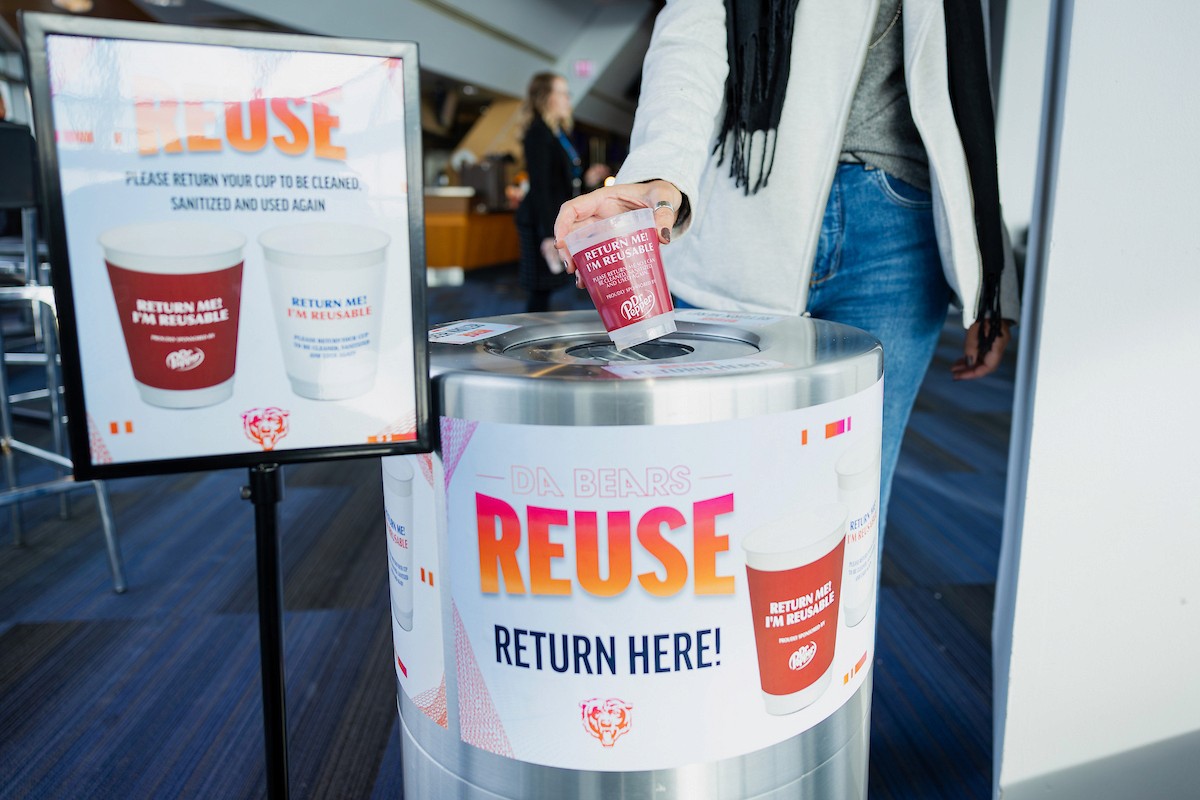
At the United Club at Soldier Field (home to the Chicago Bears), reuse launched with good intentions and execution challenges. Cups were getting lost in regular trash streams. Staff wasn’t sure where reusables were supposed to go at the end of the day.
None of that is a fan behavior problem. It’s a design problem.
A bin for reusable cups placed next to every landfill bin, so the choice was obvious in the moment
A modified lid that only fit the reusable cup, cutting down on contamination
Color-coded collection, orange bags instead of standard ones, so reuse never got mixed into general waste at the loading dock
A post-event sweep crew to catch the cups fans left behind in their seats
Janitorial staff periodically look into landfill bins and “top sort” out reusable cups before they pull bags.
The return rate without back-of-house sort is consistently at 80%, game over game.
As Emmett put it:
"It comes from within. You have to build the foundation and make sure you're streamlining the process before anything else." — Emmett Finnegan, Director of Operations, Soldier Field
Building a successful reuse program requires an internal commitment that precedes any change in fan behavior. The foundation has to be in place before new habits can take hold.
Starting a venue reuse program small builds the confidence to go big
Not every venue needs to launch reuse across an entire stadium on day one. State Farm Stadium took a different approach, beginning with employee meals rather than a guest-facing area. They started in a controlled environment serving approximately 1,200 staff members per game.
This gave them room to test processes, identify challenges, and build confidence before expanding to larger audiences.
Education was critical early on. Staff were stationed near collection points to answer questions and guide employees through the system, event after event. By the fourth or fifth event, something shifted. The people who had initially needed the most support were now helping others understand the process.
"What was really fun was by the fourth and fifth game, the people who'd had the most trouble were the ones educating the new people who hadn't done it yet.” - Eric Koncz, Director of Operations at State Farm Stadium
Return rates reached approximately 99.9%, but the most telling moment was not the number. It came when the food and beverage team forgot to put out reusable plates one day, and employees noticed and asked where the reusable serviceware was.
That level of engagement showed the program had become embedded in the culture.
Reuse and Sorting Work Together
One theme recurred throughout the conversations. Reuse does not operate in isolation.
Sorting infrastructure plays an important role in capturing what reuse does not. Stray plates, misplaced utensils, and items that miss collection points still require a pathway that keeps them out of general waste.
Beyond improving recovery rates, better sorting systems provide food and beverage partners with valuable data and visibility. A clear system in place can simplify future expansion decisions, since teams can confidently point to demonstrated results.
There is a financial benefit as well. Better separation can reduce hauling costs and create opportunities to recover value.
Common Questions, Consistent Answers
Across these conversations, several questions surfaced repeatedly, from water use and labor to storage, sponsor relationships, and concessionaire alignment.
These are legitimate considerations. Water use requires careful planning, particularly for venues operating in water-conscious regions. Labor is another key factor, though many successful programs have integrated reuse into existing workflows rather than adding significant staffing requirements.
Sponsors and concessionaires introduce additional layers of coordination, but the teams making the most progress treated these challenges as opportunities to design better systems rather than as barriers to getting started.
The Strongest Signs of Success are Not Always on the Dashboard
Return rate is an important metric, and every operator tracks it. But some of the most telling moments were harder to quantify.
It was staff teaching each other the process without being asked. It was employees noticing when reusable serviceware was missing. It was operators already thinking about where reuse could expand next.
These moments indicate that a program has moved beyond implementation and become part of how a venue operates.
The Common Thread
Every venue I spoke with started somewhere different. A club level, an employee dining area, a single operational improvement.
That may be the central lesson I took away. Successful reuse programs take shape through strong operational ownership, careful attention to detail, and a willingness to learn as the program grows. Each of these operators found their own starting point and built from there.
I am grateful to the operators who shared not only their successes but also the challenges along the way. Those lessons are often where the most valuable insights originate.