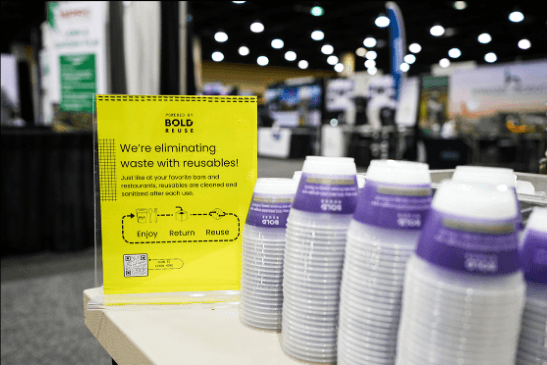
Sports venues are becoming powerful catalysts for the shift to reusable cups and foodware—proving sustainability can scale in high-volume environments. This piece explores the lessons, impact, and future of reuse in stadiums and arenas nationwide.
Bold Reuse
The Future of Reuse in Sports & Entertainment: Lessons from the Field
How stadiums and arenas are leading the charge in sustainable reuse programs—and what you can learn from their journey
Every year, the 400 stadiums across the United States dispose of over 3 billion single-use cups—and that's before counting foodware, utensils, or back-of-house items. The environmental toll is staggering, but it's also entirely solvable.
In a recent conversation between Heather Watkins, co-founder of Bold Reuse, and Mary McCarthy, Vice President of Sustainability at Levy Restaurants, we explored how the sports and entertainment industry is becoming an unexpected accelerant for reuse programs nationwide. After four years of partnership across 15 unique projects, they've learned what works, what doesn't, and where the industry is headed. And if you'd like to watch the full webinar recording, you can find that here.
Why Sports Venues Matter
Sports venues aren't just places where games happen—they're trusted community anchors that touch millions of people. When a team adopts reuse, fans see it, learn it, normalize it, and take those behaviors into their daily lives.
"We're not just reducing waste in one building," Watkins explains. "We're shaping behaviors across entire communities and even the world."
This ripple effect is already visible in cities like Portland, Seattle, Phoenix, Kansas City, and Charlotte, where reuse programs have moved from novelty to expectation.
The Journey: How It Started in Portland
The partnership between Bold Reuse and Levy Restaurants began in 2022 at Portland's Moda Center, home of the Trail Blazers. The timing was critical: the local municipality had just stopped accepting compostable foodware in compost streams because the material degraded the quality of soil being sold to organic farms.
Brittany Salisbury, Director of Sustainability at the Trail Blazers, reached out via LinkedIn with a bold question: Could they implement reuse across the venue?
"There wasn't an arena doing this stadium-wide across the country yet," Watkins recalls. "It was a real leap of faith."
They started small—testing reusable foodware in the club spaces with about 5,000 seats. The pilot was overwhelmingly successful, with a 95% satisfaction rate. Fans loved it so much they asked: Why aren't we doing this with cups? Why can't we access this across the entire arena?
In 2023, they launched the first full-venue cup program in the country. Today, the Moda Center consistently achieves 85-95% return rates per game.
The Business Case: Why Reuse Wins
1. Waste and Carbon Reduction
The environmental benefits are clear. Reuse dramatically outperforms single-use alternatives—whether plastic, aluminum, or compostable—across all environmental metrics. Even with return rates around 85% (not perfect 100%), the carbon reduction and waste savings are tremendous.
"We have to be really clear," McCarthy emphasizes. "When it comes to waste diversion and working towards our net zero commitment, reuse is the best option across all environmental metrics."
2. Sponsorship and Brand Value
Reuse programs create exciting new sponsorship opportunities. Major beverage brands like Pepsi, Coca-Cola, and Dr Pepper are investing heavily in reuse initiatives at venues—from the 49ers to Soldier Field to Arrowhead Stadium.
For Soldier Field, it was actually Dr Pepper Keurig that seeded the project. As the exclusive beverage sponsor serving RC Cola, they saw reuse as an opportunity to benefit from the brand reputation of sports while advancing their own sustainability commitments.
3. Employee Morale
Team members at venues are highly aware of waste—they're the ones pulling bags out of cans at the end of the night. Giving them the opportunity to participate in a better solution makes them genuinely excited.
"Soldier Field isn't historically known for having a strong sustainability program," McCarthy notes. "So team members felt real pride in being part of the first reuse program in Chicago."
4. Community Impact and Guest Experience
Sports teams understand their role as community anchors. Reuse programs allow venues to catalyze citywide change—as seen in Kansas City and Portland, where multiple venues now share the same reuse infrastructure.
On the guest experience side, the cups already exist in premium spaces like clubs and suites because they deliver that elevated experience. Extending reusable drinkware across the entire venue simply democratizes what's already understood as better hospitality.
5. Innovation
Teams want to be first, to do something new, to create tech-enabled experiences. The Trail Blazers embraced reuse as part of their ethos of being trailblazers on and off the court.
Within Levy, innovation is a core value. "We're always asking folks to make changes to the status quo," McCarthy says. "Having that culture of innovation goes a long way."
Overcoming Common Objections
"Reuse is too expensive."
The first question should be: compared to what? If venues are already using compostable or aluminum cups for diversion, the cost gap isn't as significant as people assume.
Bold Reuse has been maniacal about reducing costs—thinking of themselves as "the Amazon for reuse." They're working toward being cost-comparable or cheaper than single-use options, especially as Extended Producer Responsibility (EPR) fees increase the cost of disposables.
"We're talking about pennies, not doubling costs," Watkins clarifies. "And when you factor in sponsorships, grants, or even adding 5 cents to the cost of a beer, the economics work."
"This seems too complex operationally."
Change is hard, and teams naturally worry about complexity. But when operators actually walk through the journey a reusable cup takes—from loading dock to distribution to collection to pickup—they realize it's not that different from single-use.
"Our operators are consistently surprised by the ease of the program," McCarthy says.
The biggest operational challenge is inventory management in all-inclusive spaces like suites, where beverages are poured freely rather than through direct sales transactions. The solution? Implementing a simple PAR count system and being intentional about tracking.
"We don't have space."
The fear underneath this objection is usually: "We're going to run out." But reuse actually requires less space than stockpiling weeks of single-use inventory. Venues only need 2-3 days' worth of reusable products versus 3 weeks of disposables.
"Our guests won't participate."
This concern often comes from misunderstanding how dishwashing works. "That's what happens every time you go to a restaurant," McCarthy points out. "We trust dishwashers in every other place in our lives."
The data backs this up. Across 15 programs, there are virtually no guest complaints. In fact, projects like the Diamondbacks in Phoenix achieved 85% return rates without sorting—higher than Portland when it first started—because fans understand the system and are excited about the change.
The Role of Regulation
Extended Producer Responsibility legislation in Oregon and emerging regulations nationwide are making reuse more attractive. For a company like Levy, which oversees 250 locations nationally, reuse offers a strategic advantage.
"If we can get to reuse, we can get out of the complexity," McCarthy explains. "We can spend less time trying to jump from disposable to disposable as regulations and infrastructure change."
Some locations have gone through two or three rounds of transitioning between recyclables and compostables, trying to keep up with evolving legislative landscapes and unclear expectations. Reuse provides stability.
What's Next: The Future of Reuse
The trajectory is clear: growth. As wash hubs proliferate throughout the United States, the infrastructure barriers that existed just two years ago are disappearing.
Two major catalysts are on the horizon:
FIFA World Cup 2026: Spread across multiple U.S. cities
LA Olympics 2028: Concentrated high-volume events
Both are pushing for reuse and thinking about legacy—permanent infrastructure and programs that benefit communities long after the events end.
"Having a reuse program is now what leadership looks like in sports and entertainment," McCarthy says. "As new venues are being built and sustainability programs are formalized, we're going to continue seeing this become the norm."
The goal extends beyond sports venues. Cities like Kansas City are already expanding reuse from stadiums to festivals and community events, making it a shared resource.
Advice for Getting Started
If you're considering a reuse system for your venue, the advice is simple: Try it.
Start with a pilot in a controlled space. Work through the numbers honestly. Be solution-oriented about challenges. Talk to operators who've already implemented programs—they'll share real insights from people who understand the day-to-day difficulties of the business.
Most importantly, understand that this is the most sustainable option across all environmental metrics. Once that's clear, the question shifts from "Should we do this?" to "How do we make this work?"
Frequently Asked Questions
Can venues try to reuse without investing in their own inventory?
Yes! Rental and pop-up models are common for testing programs or one-time events like concerts or all-star games.
What about water usage?
This is a major misconception. The water needed to manufacture, recycle, or dispose of single-use products is immense. Reuse actually reduces water consumption. Bold Reuse's Portland operation uses about 10,000 gallons per month—the same as one household or what a high-volume restaurant uses in 1-2 days.
How can smaller communities scale up reuse?
Look locally for grants and partnerships. Some communities, like Eugene, Oregon, have used volunteers and nonprofit support to get programs started for smaller festivals. For larger venues, reach out to reuse service providers—the threshold for viability isn't as high as you might expect.
The shift to reuse in sports and entertainment isn't just about reducing waste in buildings—it's about normalizing sustainable behavior at scale. As more venues adopt these programs, they're not just solving their own waste problems; they're creating a cultural shift that extends far beyond the final whistle.
Interested in learning more about implementing reuse at your venue? The journey starts with a conversation.